


 Now in
  UAE &
UAE &  USA - For Local Support & Service

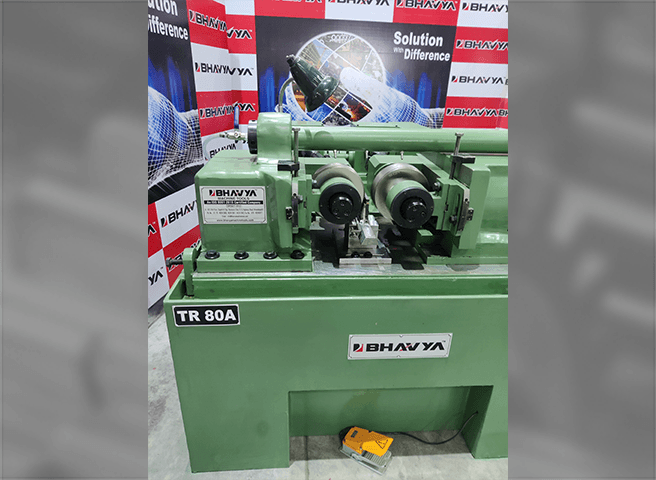
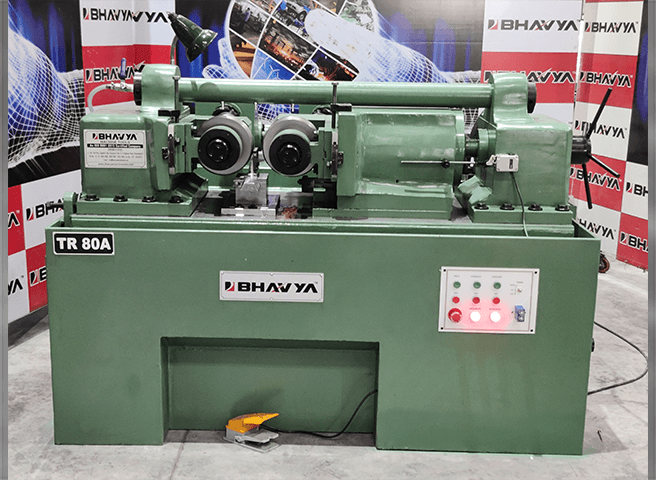
Hydraulic Thread And Form Rolling Machine
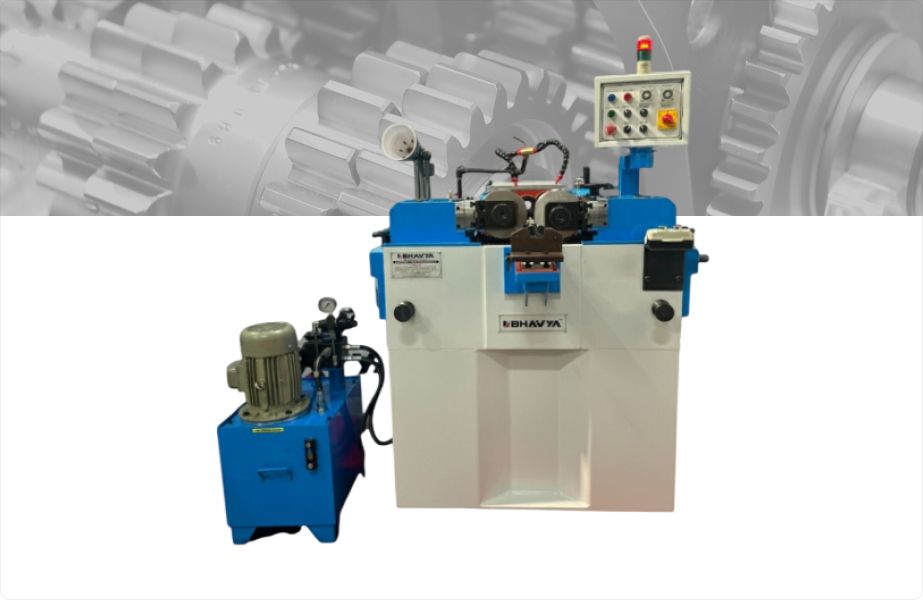
Technical Specifications
| Model | TR-20 | TR-45 | TR-70 | TR-80 | TR-100 |
|---|---|---|---|---|---|
| Max. Pitch can be Rolled (in mm) | 2 | 4 | 6 | 8 | 10 |
| Min/Max. Dia can be Rolled in Feed (in mm) | 2 to 20 | 2 to 45 | 3 to 70 | 10 to 80 | 10 to 100 |
| Max. Dia can be Through Feed | 20 | 40 | 60 | 65 | 90 |
| Max. Rolling Length Through Feed | Indefinite | Indefinite | Indefinite | Indefinite | Indefinite |
| Outer Dia of Thread Rolls (in mm) | 130 | 170 | 210 | 210 | 210 |
| Max. Die Width (in mm) | 80 | 120 | 170 | 210 | 210 |
| Spindle Dia (in mm) | 40 | 54 | 69.85 | 69.85 | 69.85 |
| Max, Rolling Force | 10 Tons | 15 Tons | 25 Tons | 30 Tons | 40 Tons |
| Power for Roll Spindles | 3 HP | 5 HP | 12 HP | 15 HP | 20 HP |
| Hyraulic motor | 1 HP | 3 HP | 5 HP | 7.5 HP | 10 HP |
| Power for Coolant Pump | 0.5 HP | 0.5 HP | 0.5 HP | 0.25 HP | 0.5 HP |
| GROSS WEIGHT (Approx) | 1300 KG | 2000 KG | 3000 KG | 4500 KG | 6000 KG |
*Specifications are subject to changed without prior notice.
Features
- Compact Design
- Fabricated steel frame
- Versatile for all type of works
- Manual & Automatic cycles
- Range of cycle times
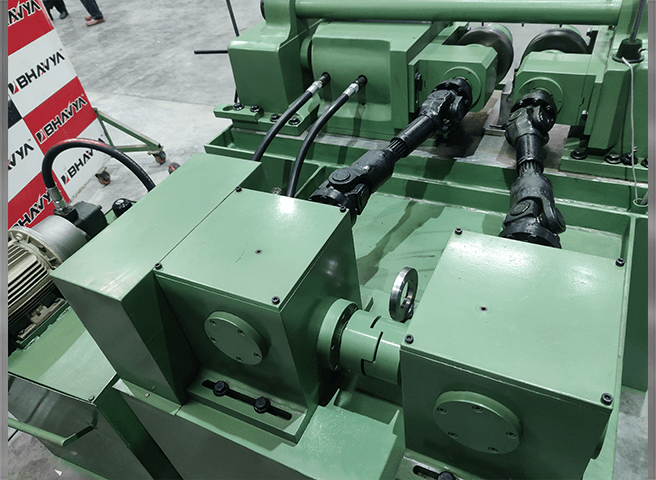
- Extended universal joint provides smooth operation for big angle of work piece
- Over sized coolant tank for superior cooling effects
- Low pressure hydraulic power pack to ensure to low heat & minimum maintenance
- CT" type and accurately ground slide assures that jumping and vibration will not happen during rolling
- Centralized lubrication of all important moving parts
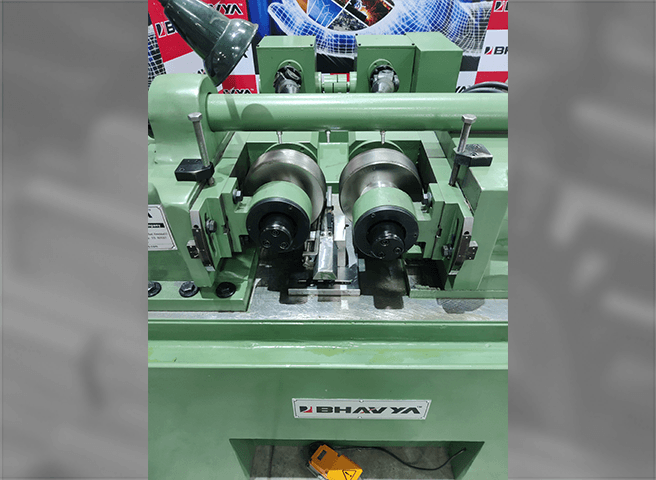
Thread rolling is a chipless cold forming process. A plain cylindrical blank, with a diameter part way between the major and minor diameters of the finished thread, is rotated and squeezed between cylindrical type hardened steel dies whose working surfaces are the reverse of the thread form to be produced. The threads of the die penetrate the surface of the black as it rolls between them, displacing material to form the roots of the threads, and forcing the displayed material readily outward to form the crests. Unlike other threading process, no material is wasted.

Most threads are rolled by the in-feed method in which the entire thread length is formed simultaneously without axial movement of the part. Threads that is too long to be produced by the in-feed method can, however, be rolled by a thru feed method on these type of Machines.
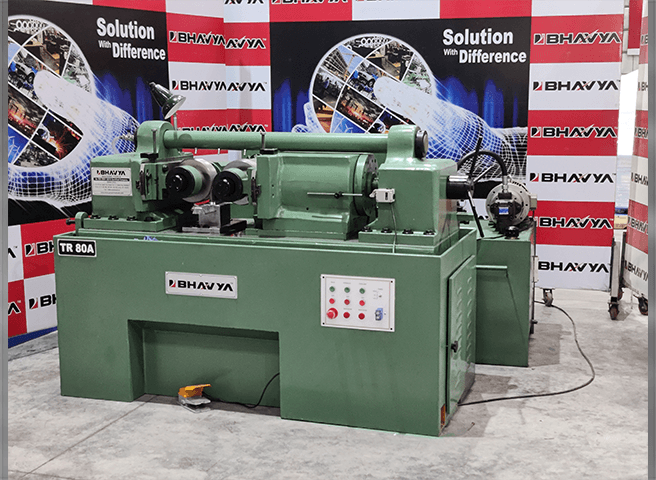
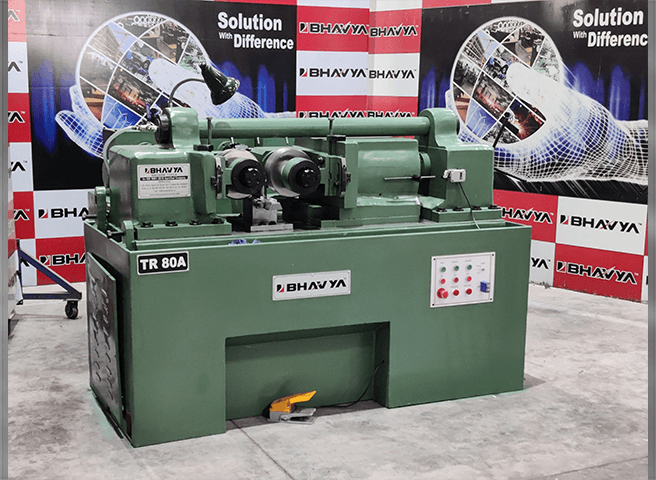
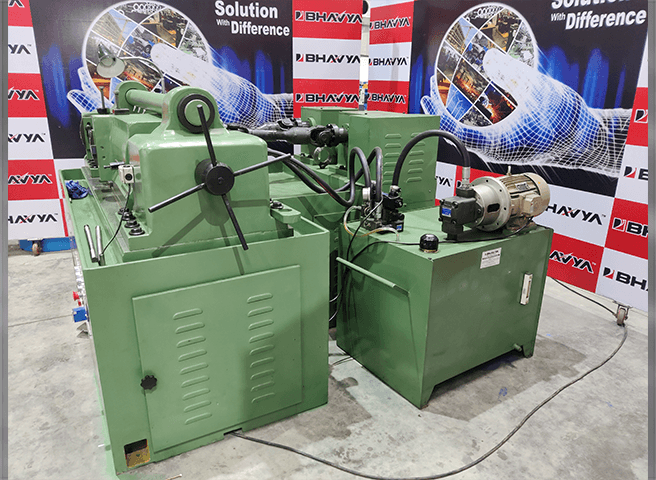
Photo Gallery
Exhibitions
Headquarters - INDIA
 Mobile: +91-9825009216
 Email: inquiry@bhavyamachinetools.com

Quick Response
International Branch - USA
International Branch - UAE
- Mobile: +971-525859112
- Email: inquiry@bhavyamachinetools.com
Headquarters
Bhavya Machine Tools LLP
Sankalp Square 3B, Office No. 907, 908 & 909, Sindhu Bhavan Marg, Beside Taj Skyline, Opp. Montecristo Banquet, PRL Colony, Thaltej, Ahmedabad - 380058.
International Branch
Bhavya Machine Tools Trading LLC
Warehouse No.1, Building 5,
FAB Properties Complex,
Dubai Investment Park First,
Plot No. 598653,
Dubai, UAE.
Showroom
Bhavya Machine Tools
Plot No. 3, Survey / Block No. 86, PO. Vasna Chancharwadi, Nr. Divya Bhaskar Press, Bavla - Changodar Highway, Ta.: Sanand, Dist.: Ahmedabad - 382213, Gujarat, India.



Our Wide Range Of Workshop Machinery
- Bandsaw Machines
- Bending / Press Brake Machines
- CNC Lathe Machines
- Centerless Grinding Machines
- Cutting/Shearing Machines
- Electric Tapping Machines
- Hydraulic Press Machines
- Laser Machines
- Lathe Machines
- Milling Machines
- Pillar Drill Machines
- Pipe / Profile Machines
- Power Press Machines
- Radial Drill Machines
- Slotting Machines
- Threading Machines
- Fiber Laser Marking Machine
- Fiber Laser Cutting Machine
- Shearing Machine
- Folding Machine
- Saw Blade Sharpener
- NC Press Brake Machine